Answering your search for sustainable to-go containers, this guide highlights five eco-friendly take-out options. These containers are designed for hot and cold foods, offer strong leak resistance, and align with compostable or biodegradable materials. They’re best suited for home meal prep, small businesses, catering, and event take-outs where minimizing plastic waste matters.
Summary of selected products (quick comparison):
| Product | ||
|---|---|---|
| Aricsen 100 Pack 9×6 Takeout | Businesses and households needing bulk supply | Heavy-duty, PFAS-free, microwave-safe |
| HorizonNest 34 oz Take Out Boxes | Sustainable meal prep and catering | Sugarcane pulp, 100% biodegradable |
| Fit Meal Prep 9×6 To Go Containers | Meal prep and home use | Bagasse-based, PFAS-free, sturdy for hot/cold |
| Freshware 8×8 Clamshell | Bar/restaurant takeout and parties | PFAS-free, bamboo + bagasse blend, microwave-safe |
| Stack Man 6×6 To-Go | Compact portions and quick service | 100% sugarcane fiber, fully compostable |
Aricsen 100 Pack 9×6 Takeout Containers

Best for bulk use in homes or small businesses that need reliable, compostable packaging. The 100% compostable design is made from FSC-certified paper and is PFAS-free, making it suitable for hot and cold foods. They resist oil and moisture, and are microwave-safe. Use this when you want a heavy-duty, eco-friendly option that scales well for events or daily service.
Selected for: high-volume needs, strong performance, and a clear eco-claim. Limitation: actual composting timelines depend on facility conditions.
[100% Eco-Friendly] HorizonNest 34 oz Take Out Containers

Best for sustainable meal prep and catering where 34-ounce portions suit portion-control needs. Made from sugarcane pulp, these containers are 100% compostable and plastic-free. They withstand reheating and freezing without warping, making them versatile for leftovers and meal-prep workflows.
Selected for: strong, leak-resistant design and compostable materials. Limitation: larger sizes may be more expensive per unit than simpler options.
Fit Meal Prep 9×6 To Go Containers

Best for home meal preppers and small offices needing a value-pack option. Constructed from bagasse (sugarcane fiber), these containers are 100% compostable and PFAS-free. They are designed to handle hot and cold foods and include a secure hinged lid to prevent leaks.
Selected for: balanced size, strong construction, and eco-friendly material. Limitation: may be bulkier than standard plastic equivalents.
Aricsen 50 Pack 9×6 Takeout Containers
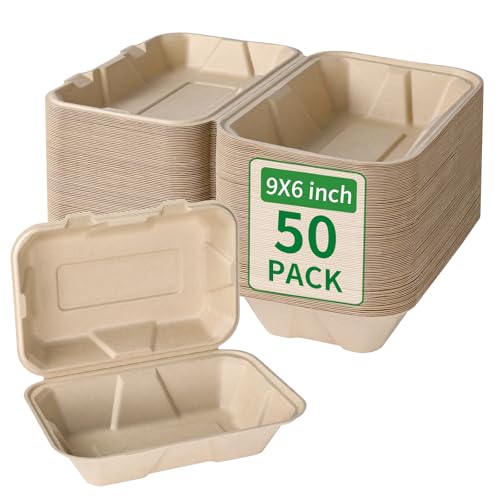
Best for smaller batches or trial runs where a mid-volume supply is sufficient. The 50-pack uses the same compostable, PFAS-free design as the larger bundle, making it a flexible option for event catering or periodic meal services. It’s microwave-safe for convenience.
Selected for: cost-effective middle-ground and consistent eco-credentials. Limitation: fewer units than the 100-pack options, so restocking speed matters.
Freshware Compostable Clamshell 8×8, 50-Pack

Best for restaurant takeout and events where a sturdy, heavy-duty disposable option is needed. The 8×8″ clamshell uses a bamboo and bagasse blend, is PFAS-free, and is fully compostable. It’s microwave-safe and designed to resist leaks, making it versatile for varied menus.
Selected for: high-quality feel and strong performance. Limitation: larger footprint may not suit compact packaging requirements.
Stack Man 6×6 Take Out Containers

Best for compact portions and quick-service scenarios. Made from 100% sugarcane fiber, these containers are 100% compostable and designed to meet typical to-go needs without sacrificing strength. They’re a solid option for salad, sandwiches, and small side dishes.
Selected for: tree- and plastic-free credentials and straightforward use. Limitation: smaller size may require multiple units for larger meals.
Buying Guide
What material should I choose for eco-friendly to-go containers?
Options include bagasse (sugarcane fiber), bamboo blends, and FSC-certified paper. Bagasse containers are typically sturdy, moisture-resistant, and compostable. Paper-based options are often lighter and pack well for bulk orders. PFAS-free labeling is important to avoid fluorinated compounds.
Are these containers safe for microwave use?
Most options in this list are microwave-safe, but always verify the specific model. Microwave compatibility allows reheating without transferring harmful substances. If reheating is frequent, prioritize microwave-safe designs with good insulation properties.
How do I determine the right size and capacity?
Consider typical meal portions: 6×6 inches is good for single servings like sandwiches or salads, while 9×6 inches fits main courses or larger meals. For desserts or side dishes, 6×6 or 8×8 can work well. Bulk orders should balance unit count with expected usage to minimize waste.
What is the environmental impact of compostable containers?
Compostable containers break down in commercial or home composting facilities. Look for materials sourced from renewable resources and certifications like ASTM or BPI (where applicable). Decomposition timelines vary by facility and conditions.
Are there limitations with restaurant use?
Some compostable containers may be more expensive per unit and have shorter shelf-life in inventory. They can also require careful handling to avoid leaks with oily foods. Consider combining compostable options with reusable ware where feasible to balance cost and sustainability.
What about labeling and compliance?
Use clearly labeled eco-friendly packaging and provide disposal guidance for customers. If your operation serves a broad audience, include simple disposal instructions to maximize composting efficiency and minimize contamination.
Frequently Asked Questions
- What makes to-go containers eco-friendly?
- Can I use compostable containers for hot foods?
- Are there clean disposal guidelines I should follow?
- Which size is best for meal prep businesses?
- Is there a trade-off between cost and eco-friendliness?
Materials like bagasse (sugarcane fiber), bamboo blends, and FSC-certified paper reduce plastic use and are typically compostable, PFAS-free, and renewable. These features minimize environmental impact compared to traditional plastic containers.
Yes, many compostable containers are designed to handle hot foods, but check heat limits and lid design to prevent leaks and deformation.
Provide customers with disposal instructions matching local composting capabilities. Encourage composting where facilities exist and avoid contamination with non-compostable items.
For meal prep, 9×6 or similar sizes offer flexibility for main courses, sides, and desserts. Stock a mix of sizes to cover different menu items and portion requirements.
Generally, eco-friendly containers cost more per unit than standard plastics. Bulk purchases and varied pack sizes can reduce per-unit costs while maintaining sustainability goals.