Answer: If you’re selecting a pressure canner, choose models that balance capacity, safety features, and compatibility with your stove. The best options below cover large-batch canning, dual-use canning and boiling, compact setups for small kitchens, and induction compatibility. These picks suit: large families or gardeners (large volumes), hobbyists with limited space (compact), cooks who want multi-purpose versatility (2-in-1), and those using induction stoves (induction-ready). The following table highlights the five selected products and their primary strengths.
| Product | Best For | Key Benefit |
|---|---|---|
| Presto 01781 23-Quart Pressure Canner and Cooker | Large families, garden canners | USDA-recommended method; doubles as boiling-water canner; long warranty |
| T-fal 22-Quart Aluminum Pressure Canner | Versatile home canning | 3 PSI settings; includes racks and canning guide; large capacity |
| 4.2 Quart Pressure Cooker (Small, Magnetic Bottom) | Compact kitchens, RVs | Space-saving; works on induction and gas; fast, energy-saving |
| Barton 22 Quart Pressure Canner | Bulk canning, big batches | Large capacity with pressure gauge; durable aluminum |
| 25 Quart Pressure Canner Cooker | Induction-ready, all-in-one | 2-in-1 canner and cooker; high capacity; includes accessories |
Presto 01781 23-Quart Pressure Canner and Cooker

The Presto 01781 uses the USDA-recommended method for safe home canning of vegetables, meats, poultry, and seafood. It also doubles as a boiling-water canner for fruits, jams, jellies, pickles, and salsa, and serves as a large-capacity pressure cooker. Constructed from warp-resistant heavy-gauge aluminum, it promises fast, even heating and works on regular and smooth-top ranges. It includes an extended 12-year limited warranty. Best for households planning large batch canning and long-term preservation; avoid if you need a compact unit or induction compatibility.
T-fal 22-Quart Aluminum Pressure Canner
The T-fal model offers three PSI settings and includes racks and a canning guide, making it versatile for vegetables, meats, seafood, and fruits. It’s best for canners who want guidance and adjustable pressure options in a single unit. Choose this if you value built-in guidance and a high-capacity option; better for those who don’t need induction compatibility or extra-large dimensions.
4.2 Quart Pressure Cooker With Magnetic Bottom

This compact option is designed for small kitchens or travel-friendly use. It features a magnetic base for induction compatibility and gas cooktops, a dual-layer design for simultaneous steaming and simmering, and high-efficiency pressure performance that can shorten cooking times. Best for individuals or couples with limited space; choose this if you need induction compatibility in a small footprint. A limitation is its smaller capacity, not ideal for large batch canning.
Barton Pressure Canner Release Valve (22 Quarts)

The Barton 22-quart pressure canner comes with a release valve and a built-in pressure gauge, offering a large-capacity solution for vegetables, meats, and seafood. It doubles as a boiling-water canner for fruits and preserves, making it ideal for gardeners preserving large harvests. Best for users who want a traditional 22-quart setup with a gauge; caution: ensure proper valve operation and gauge accuracy to maintain safe pressure levels.
25 Quart Pressure Canner Cooker
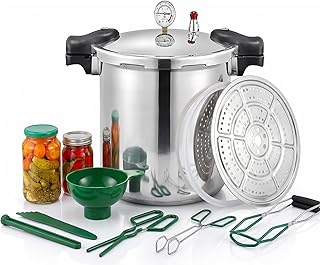
Rated as an all-in-one unit, this 25-liter (approximately 25-quart) pressure canner and cooker supports induction compatibility and a wider PSI range up to 15.5 PSI. It includes a canning rack, spare seal ring, and a collection of accessories to support both pressure canning and water-bath canning. Best for those who want a large-capacity, induction-friendly option with full accessory suite; consider this if you need a broad kit for both pressure canning and general cooking. One limitation is the abundance of included accessories which may be more than some setups require.
Buying Guide: Key Considerations For Pressure Canners
- Capacity vs. space: Choose 22-23 quart for most family needs, 25+ quarts for large harvests, or 4-6 quarts for compact kitchens.
- Safety features: Look for sealed lids, proper locking mechanisms, pressure gauges, and documented safety guidelines. Induction compatibility adds flexibility in stove choice.
- Purposed use: Decide between pressure canning only, multi-use (pressure canner and cooker), or combined boiling-water canning capability.
- PSI settings: 5-15.5 PSI is common; models with adjustable PSI are more versatile for different foods.
- Included accessories: Racks, canning funnels, jar lifters, and manuals help with setup and operation.
- Maintenance and warranty: Long warranties and durable materials reduce long-term costs and risk of warping or leaks.
Frequently Asked Questions
- What makes a pressure canner USDA-approved? Answer: It follows validated canning methods and produces safe, tested pressure and temperature levels for proper preservation.
- Is a larger canner always better? Answer: Not necessarily. It’s best if you regularly process large batches; smaller units suit limited spaces and occasional use.
- Can I use a pressure canner as a normal pot? Answer: Yes, most canners function as standard pots with boiling-water canning or regular cooking, depending on design.
- Do I need induction compatibility? Answer: Induction compatibility is helpful if you have an induction stove, but not essential if your stove is gas or electric.
- How important is a pressure gauge? Answer: A gauge helps monitor accurate pressure; many models include a weight regulator or indicator for safety and consistency.
- What foods require pressure canning? Answer: Vegetables, meats, poultry, seafood, and some non-acidic items should be pressure canned for safe preservation.