Looking for a compact oil press that fits a home kitchen or small workshop? This guide highlights five mini oil press machines ideal for extracting oil from peanuts, sesame, sunflower, and other seeds. Each pick is evaluated for ease of use, efficiency, and suitability for different buyers—from health-focused households to hobby farmers. The top options emphasize hands-on control, safety features, and straightforward cleaning, while offering varying modes like hot pressing, cold pressing, or both. Use the quick comparison below to decide which mini oil press best fits your needs.
| Product | Best For | Key Benefit | Limitations |
|---|---|---|---|
| VEVOR Manual Oil Press Machine | Home cooks who want simple operation | Detachable design for easy cleaning; hot pressing for higher yield | Manual lever requires effort |
| Rkazes 820W Oil Press Machine | Small workshops and serious hobbyists | Hot and cold modes; strong motor; real-time temperature display | Long warm-up time possible |
| Piteba Nut and Seed Oil Expeller | US-based shippers and small farms | Original design; continuous expelling; simple maintenance | Manual operation; slower output |
| awolsrgiop 1500W Oil Press Machine | Health-conscious users and frequent users | Intelligent temperature control; LCD touch panel | Higher price point |
| 1500W Oil Press Machine With Double Outlets (SISAYWEY) | Dual-material processing and small business use | Two independent motors; two oil outlets; efficient | Bulkier footprint |
Buyer profiles: the best-fit buyers include budget-conscious households, aspiring small-scale farmers, hobbyists wanting to experiment with multiple seeds, and those needing consistent throughput for occasional small batches. The following sections provide product-specific details, practical pros and cons, and why each option was selected for particular use cases.
VEVOR Manual Oil Press Machine

The VEVOR model uses a traditional hot-pressing method with a manual lever, aimed at households seeking a straightforward, smoke-free oil extraction process. Best for: cooks who want a compact, easy-to-clean machine and are comfortable with manual operation. Why selected: detachable components simplify cleaning, and the design supports efficient pressure application. Limitation: manual operation can be labor-intensive for large batches. Key user note: preheat the unit before pressing to improve extraction efficiency, and monitor the temperature to avoid overheating the pressure frame.
Rkazes 820W Oil Press Machine

The 820W Rkazes unit offers both hot and cold press modes and is built for home and light commercial use. Best for: users who want flexibility across seeds and want a real-time temperature readout for precise control. Why selected: dual modes support different materials, and the all-steel gear system aims for durability and consistent output. Limitation: heavier and more complex than basic models, which may require more space and setup time.
Rkazes 1800W Automatic Seed Oil Press
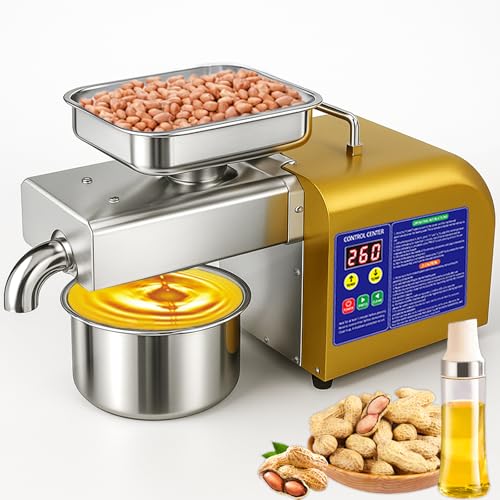
The higher-powered Rkazes model is designed for faster throughput and can handle a broader set of seeds. Best for: users needing higher output and longer continuous operation. Why selected: an 1800W rating supports pressing sessions of up to 24 hours and a wide temperature range for gourmet and industrial-quality oil. Limitation: freshly pressed oil may appear turbid and require settling time before use, which can affect immediate consumption plans.
awolsrgiop 1500W Oil Press Machine

This model emphasizes intelligent temperature control with an LCD touch screen and a stainless steel build, aiming at users who value precise oil output control. Best for: health-focused households that want consistent results and easy monitoring. Why selected: digital temperature control helps optimize oil yield and quality. Limitation: higher initial cost and a larger footprint than purely manual units.
HinLIaDa Commercial Automatic Oil Press

HinLIaDa’s device is a compact commercial-grade press with stable output and adjustable 50-250℃ ranges. Best for: small businesses or serious hobbyists who require a sturdy machine and adjustable temperature control. Why selected: solid stainless steel construction and broad material compatibility. Limitation: may be more expensive and less suited for extremely small batch sizes.
CGOLDENWALL Manual Cold Oil Press

This manual unit uses a traditional cold-press approach with a stainless steel body and a robust hand crank. Best for: buyers prioritizing chemical-free pressing and a simple, durable mechanism. Why selected: pure physical pressing, no chemicals, and a 304 stainless steel construction. Limitation: low output and more physical effort required; not ideal for high-volume needs.
Buying Guide: Practical Considerations For Mini Oil Presses
- Pressing method: Choose hot pressing for higher yield and faster throughput, but note potential nutrient loss in some seeds. Cold pressing preserves flavor and nutrients but may yield less oil.
- Power and throughput: For home use, 500-1500W units provide a balance between effort and output. For small business use, consider 1500-1800W models with dual motors or higher hour capacities.
- Material compatibility: Check which seeds each model supports. Most work with peanuts, sesame, sunflower, and similar seeds; some models explicitly exclude olives or flax.
- Temperature control: Digital temperature displays help maintain consistent oil quality. Manual models rely on preheating and experience to optimize yields.
- Cleaning and maintenance: Detachable parts and stainless steel construction simplify cleaning. Consider models with fewer crevices to minimize residue buildup.
- Safety features: Look for heat shields, insulated handles, and automatic shutoffs where available to reduce burn risk during operation.
- Space and noise: Larger commercial units may require more counter space and produce noticeable noise. If space is tight, prioritize compact, lighter designs.
FAQ
- What seeds can mini oil presses handle? Most are suitable for peanuts, sesame, sunflower, and similar seeds, but always verify each model’s material compatibility.
- Do all mini oil presses require preheating? Some models use hot pressing and require preheating; others use cold pressing or hybrid modes with different setup needs.
- Is manual operation feasible for daily use? For small batches, yes. For frequent daily use, electric or automatic models reduce effort and improve throughput.
- Can freshly pressed oil be used immediately? Some oils may require settling or filtration to achieve clarity and remove solids; check product notes for specifics.
- Are these machines safe for home kitchens? Most are designed with kitchen-safety in mind, featuring steel bodies and heat management, but exercise caution around hot surfaces.
- What maintenance is required? Regular cleaning of the pressing chamber and oil outlet helps prevent clogging and preserves efficiency.