Find the best extractor fan for a kitchen ceiling that fits your space and budget. This guide highlights top 5 options, focusing on ceiling-ready or wall-to-ceiling setups, and explains who each model suits best. Ideal buyers include condo owners needing compact but powerful ventilation, small restaurant chefs seeking steady performance, and homeowners upgrading kitchen ergonomics with quieter operation and energy efficiency.
Overview of selected products:
| Product | Brand | CFM | Why it stands out |
|---|---|---|---|
| Amico 8 Inch Kitchen Exhaust Fan With Remote | Amico | 686 | High airflow with smart remote and 9 speeds for versatile kitchen use |
| HG Power 8 Inch Kitchen Exhaust Fan | HG Power | 576 | Robust metal build and low energy consumption |
| HG Power 8 Inch Exhaust Fan With Speed Controller | HG Power | 576 | Adjustable speed and damper for flexible ventilation |
| Broan-NuTone 505 Exhaust Fan | Broan-NuTone | 200 | Versatile, easy installation between joists with standard sizing |
| Broan-Nutone L400 High Capacity Ventilator Fan | Broan-NuTone | 434 | High-capacity for demanding spaces with customizable ducting |
Amico 8 Inch Kitchen Exhaust Fan With Remote

The Amico model delivers 686 CFM with a high-speed 2873 RPM motor, making it suitable for kitchens generating heavy heat, steam, or strong cooking odors. It includes a wireless remote and 9 speed settings, enabling precise control from across the room. The 29W EC motor emphasizes energy efficiency while maintaining strong airflow.
Best for: Kitchens with frequent high-heat cooking or households that value remote control and fine-tuned ventilation. Choose this if you want robust performance with customizable airflow and a modern control experience.
Caution: Remote parts availability should be checked in case of a component issue or replacement need. Noise levels can be noticeable at the highest speeds.
HG Power 8 Inch Kitchen Exhaust Fan

This HG Power unit provides 576 CFM through a sturdy metal construction and an efficient motor, targeting reliable performance for kitchens, basements, or garages. It’s designed for wall-mounted or ceiling use, with solid durability and energy-conscious operation at 53.5W.
Best for: Home cooks who need steady, dependable venting with a durable metal build. It’s a practical choice when you want a balance of airflow, efficiency, and long-lasting materials.
Limitation: While powerful, it lacks the remote control features found on some multi-speed models, which may matter for users who value fingertip control from anywhere in the room.
HG Power 8 Inch Exhaust Fan With Speed Controller

This model blends strong airflow with an adjustable speed controller and a damper, enhancing control over various spaces such as kitchens, attics, or basements. The 576 CFM rating ensures effective ventilation, while the damper helps minimize backdrafts and energy losses.
Best for: Users needing flexible airflow with a built-in damper for draft control. It’s a solid option when you want customizable ventilation without a remote control.
Limitation: The control is on the unit itself, which may be less convenient for multi-room setups compared with remote-operated fans.
Broan-NuTone 505 Exhaust Fan
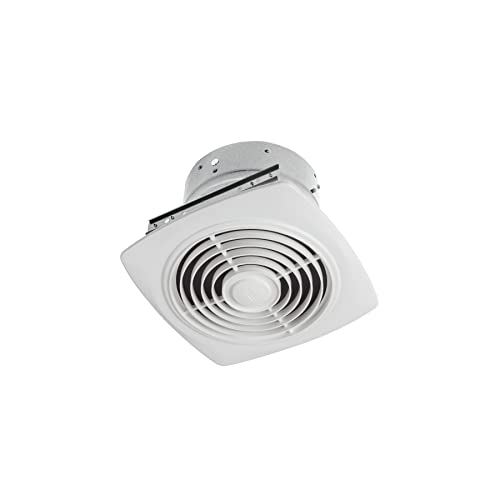
The Broan-NuTone 505 offers 200 CFM of exhausting power with 8.5 sones for a reasonably quiet operation in compact spaces. It’s a galvanized steel unit designed for between-ceiling joists installation and can integrate with standard IAQ systems for broader ventilation.
Best for: Smaller kitchens or bathrooms where quiet operation and straightforward installation between joists are priorities. Choose this if you want a simple, dependable option with familiar installation dimensions.
Limitation: Lower airflow compared to larger commercial models, which may not suit high-heat, high-odor environments without longer runtimes.
Broan-Nutone L400 High Capacity Ventilator Fan

The L400 is a high-capacity commercial-style ventilator, delivering 434 CFM with a 2.3 sones rating. Its robust construction includes a heavy-duty duct connector, enabling flexible ducting options for larger kitchens, workshops, or utility rooms requiring stronger airflow.
Best for: Medium to large spaces needing reliable, high-capacity exhaust with customizable duct configurations. Opt for this when venting demands exceed typical residential needs.
Limitation: Higher airflow can translate to more noticeable noise at peak operation, and installation may require more planning for duct routing.
Buying Guide
What to consider when choosing a kitchen ceiling extractor fan:
- Airflow needs: Measure your kitchen size and typical heat/smoke levels to determine CFM. Higher CFM is better for busy kitchens or open-plan layouts.
- Control options: Remote controls and multiple speeds offer precision. Built-in speed controllers are simpler but less flexible for multi-space use.
- Energy use: EC motors and low wattage designs save electricity over time. Look for models that balance airflow with efficiency.
- Installation type: Decide between ceiling-mounted, wall-to-ceiling, or between-joist installations. Duct compatibility and ease of access affect durability.
- Durability and materials: Metal housings resist corrosion and moisture. A backdraft damper helps prevent outside air from entering when the fan is off.
- Noise considerations: Look for lower sones ratings for quieter operation, especially in open-plan kitchens or spaces near living areas.
- Maintenance and parts availability: Check for remote parts, replacement blades, and compatibility with standard duct sizes.
- Space constraints: For compact ceilings or tight corners, select models with more compact housings or flexible mounting options.
FAQ
- Which extractor fan is best for a small kitchen with limited ceiling space?
– A compact, high-efficiency model with simple mounting between joists, such as a 200–434 CFM option, may fit best while providing adequate ventilation. - Is remote control necessary for kitchen exhaust fans?
– Not necessary, but it improves convenience, especially in larger kitchens or open-plan layouts where mounting reach is limited. - What does CFM tell me about performance?
– CFM (cubic feet per minute) measures how much air the fan moves. Higher CFM is better for larger or more heavily used kitchens. - Are built-in dampers important?
– Yes, dampers reduce backdrafts and energy waste when the fan is off, improving overall efficiency. - Can these fans be used for other rooms like garages or basements?
– Many models are versatile and suitable for attics, garages, or basements, depending on space and venting needs. - What maintenance is required?
– Regular cleaning of blades and housings, checking for damper function, and ensuring duct connections are sealed and unobstructed.