Answering your search, these espresso machines excel at delivering café-quality shots and include built-in cup-friendly features, making them ideal for home baristas and small offices. The top picks cover compact options, milk frothing capabilities, pressure control, and user-friendly interfaces. This guide explains who should choose each model and why, with practical notes on limits to consider.
Summary of selected products
| Product | Best For | Key Benefit | Limitations |
|---|---|---|---|
| CASABREWS 3700 Essential | Home or small office, latte lovers | 20-bar pump and powerful steam wand | Large water tank; may require space |
| CASABREWS CM5418 Compact | Beginners to intermediate users | Built-in pressure gauge for tuning | Smaller footprint, moderate tank |
| Keurig K-Elite | Single-serve convenience, faster mornings | Multiple cup sizes, strong brew option | Not a traditional espresso maker |
| Fellow Espresso Series 1 | Aspiring baristas seeking guidance | Built-in presets and shot feedback | Premium price, learning curve for advanced control |
| Nespresso Vertuo Next | Compact footprint with wide cup options | Six cup sizes, crema-rich espressos | Uses Nespresso-compatible capsules only |
CASABREWS 3700 Essential Stainless Steel Espresso Machine

Best for users who want a full-featured home espresso setup with strong milk frothing ability. The 20-bar professional pump and 1350 W boiler support rich aroma and crema. The compact stainless steel body suits modern kitchens and small offices. The built-in milk frother helps create cappuccinos and lattes with microfoam texture. Caution: the water tank, while removable, is sizable and may require countertop clearance.
Who it’s for: home baristas who value a robust steam wand and a durable build. Why selected: combines professional pressure with a stylish form factor for daily use.
CASABREWS CM5418 Compact Espresso Machine

Best for beginners who want built-in gauges and straightforward operation. The 20-bar pump and 1350 W boiler deliver reliable extractions, and the built-in pressure gauge helps dial in flavor. The powerful steam wand textures milk for lattes and cappuccinos. Caution: like many compact models, the water reservoir capacity is moderate, so refills may be needed for multiple drinks in a row.
Who it’s for: new home baristas who want a guided, hands-on feel without overcomplication. Why selected: the pressure gauge supports learning and adjustment over time.
Keurig K-Elite Single Serve Coffee Maker

Best for households prioritizing convenience over traditional espresso. This machine supports multiple cup sizes (4, 6, 8, 10, 12 oz) and offers a strong brew option. It is not an espresso machine in the classic sense, but it excels at quick coffee needs with milk frothing compatibility via add-ons. Caution: it uses K-Cup pods, which limits customization compared to ground espresso.
Who it’s for: busy kitchens needing fast, consistent drinks. Why selected: unmatched speed and versatility for mixed beverage routines.
Fellow Espresso Series 1 – Espresso Machine

Best for aspiring baristas who want guidance and growth. The machine provides beginner-friendly on-screen prompts and built-in presets, with options to adjust temperature and pressure for more control as skills improve. It includes shot feedback to help refine technique. Caution: advanced users may outgrow presets and require more manual control space than some compact models.
Who it’s for: new and developing espresso makers seeking educational cues and consistency. Why selected: combines approachable use with room to grow into more precise extraction control.
Nespresso Vertuo Next Coffee & Espresso Maker
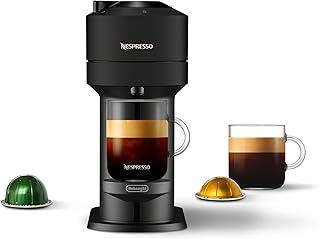
Best for compact spaces that still want a wide cup-size range, including espressos and lungo options. Vertuo Next uses capsules to deliver crema-rich espresso with a smooth body and is slim enough for tight counters. Caution: limited by capsule system, which might affect long-term flexibility and ongoing capsule costs.
Who it’s for: users seeking effortless, fast coffee without manual grinding. Why selected: six cup sizes and crema-rich results in a compact design.
Buying Guide: Key Purchase Considerations
What matters most when choosing an espresso machine with cups?
- Brewing style: Do you want a traditional espresso machine with a milk frother or a capsule-based unit for quick drinks?
- Pressure and temperature: Look for at least 15-20 bars and accurate temperature control to ensure crema and flavor.
- Milk frothing: If you enjoy lattes and cappuccinos, prioritize a robust steam wand or integrated frothing system.
- Tank size and footprint: Consider countertop space and how often you’ll refill the water reservoir.
- Maintenance: Removable parts and easy descaling support keep machines reliable with less effort.
- Flexibility vs. simplicity: Beginners may prefer presets, while advanced users might want precise control over extraction.
Product-specific notes in a quick compare format:
- Best overall for home baristas: CASABREWS 3700 Essential — strong pump, solid milk frothing, durable build.
- Best learning model with gauge: CASABREWS CM5418 Compact — precise pressure gauge aids learning.
- Best for convenience: Keurig K-Elite — quick drinks, multiple sizes, not traditional espresso.
- Best for guided learning: Fellow Espresso Series 1 — on-screen prompts and feedback help growth.
- Best compact capsule option: Nespresso Vertuo Next — six cup sizes, crema-rich drinks in a slim chassis.
Frequently Asked Questions
- Do I need a dedicated espresso grinder with these machines?
- Which machine is best for beginners?
- Are capsule machines less customizable than traditional espresso makers?
- What is a practical cup-size range to consider?
- Is a built-in pressure gauge essential?
Some models use ground coffee or capsules; check each product’s compatibility. Grinder choice matters for traditional espresso to optimize grind size and extraction time.
The CASABREWS CM5418 and Fellow Espresso Series 1 offer guidance features and preset options that help new users progress.
Capsule machines are generally less flexible, as they use pre-measured ingredients. They offer convenience but limit grind, dose, and tamp control.
Look for models supporting standard espresso shots (1-2 oz) and milk-based drinks (latte, cappuccino) with at least 6-8 oz and up to 12-18 oz variants where desired.
Not essential for all buyers, but it helps beginners and intermediate users adjust espresso grind and tamp to taste, improving repeatability.