What’s the right vegetable chopper for a restaurant? This guide highlights top commercial options, focusing on durability, efficiency, and ease of cleaning. It’s ideal for busy kitchens, prep crews, and catering operations that need consistent cuts. Below, five models are evaluated for professional environments, with tips on who each is best for and why. A quick buying table follows to help compare core specs at a glance.
| Product | Blade Options | Frame Material | Best For |
|---|---|---|---|
| VEVOR Commercial Vegetable Chopper | 4 blades (1/2”, 3/8”, 1/4”), 6-wedge slicer | Stainless steel, aluminum | High-volume prep with multiple cut sizes |
| POWLAB Commercial Vegetable Chopper & French Fry Cutter | 1/4”, 1/2”, 3/8” blades | Aluminum alloy frame | Efficient, large-batch dicing |
VEVOR Commercial Vegetable Chopper w/ 4 Blades

Best for high-output kitchens that need multiple cut sizes in a single station. The unit combines stainless steel and aluminum for a sturdy profile and corrosion resistance. It includes four blades: 1/2 inch, 3/8 inch, 1/4 inch, plus a six-wedge slicer, with two spare blades per blade set. Ergonomic pull-down handling reduces operator fatigue during long prep shifts. Best for restaurants that require consistent dicing and fry-cutting throughput.
Who it’s for: large kitchens with frequent French fry prep, salads, and diced vegetables. Why selected: the 4-blade array and durable construction address volume and hygiene requirements. Limitation: cleaning all blade channels can take extra care to maintain hygiene standards.
POWLAB Commercial Vegetable Chopper & French Fry Cutter

This model emphasizes efficient, time-saving performance with a robust aluminum frame and a manual cutting system. It can dice vegetables into 1/4″, 1/2″, and 3/8″ pieces, meeting a range of prep needs. Its die-cast construction supports frequent use in a professional setting, and easy disassembly aids quick cleaning. Best for operations that prioritize speed without sacrificing blade variety. Caution: ensure all parts are fully dry before reassembly to prevent corrosion.
BotaBay Commercial Vegetable Fruit Chopper

Best for menus that require 6-wedge slicers and multiple blade sizes for uniform dicing. The BotaBay model offers a 6-wedge slicer along with 1/4″ and 3/8″ blades, all in an aluminum alloy frame designed for durability. It’s well-suited for high-volume prep lines dealing with peppers, onions, tomatoes, and potatoes. Limitation: some users may find assembly steps lengthy during initial setup.
VEVOR Commercial Vegetable Chopper 1/4″ Blade

Best for kitchens that want a dedicated 1/4″ blade option with solid health standards. This unit uses 420J2 stainless steel blades and a stainless steel construction to support hygiene and long-term use. The 1/4″ blade is sharp and sturdy, with two spare blades included. Choose this if your menu often requires uniform 1/4″ dice and you value blade longevity. Caution: ensure the blade guard is properly installed for safe operation.
POWLAB Commercial Vegetable Chopper, 1/4″

Best for operators needing a reliable 1/4″ dice with easy maintenance. The POWLAB 1/4″ model uses an aluminum die-cast frame and a heavy-duty blade design to support continuous use in busy kitchens. It’s designed for high efficiency and quick disassembly for cleaning. Better for: smaller prep areas within larger kitchens that still require consistent 1/4″ cuts. Limitation: not as many blade options as some multi-blade units.
TERUISI 4-In-1 Electric Vegetable Chopper
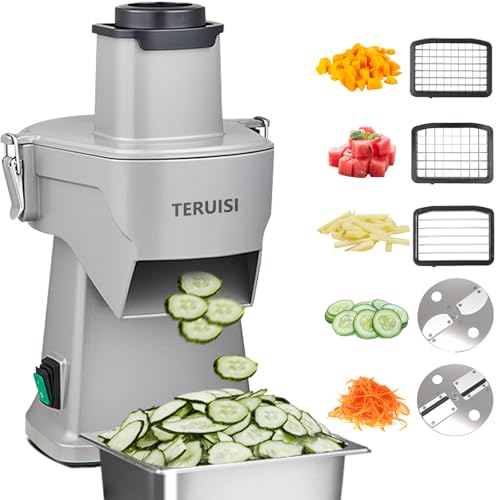
Best for kitchens seeking an electric option with multiple functions. This 200W cutter includes slicing, shredding, dicing, and striping with adjustable thickness. It uses a cast aluminum body with 420 stainless steel blades for improved durability and longer life. It’s suitable for back-to-back prep cycles in medium to large operations. Caution: electric units require regular maintenance to prevent overheating during extended use.
BotaBay Commercial Vegetable Chopper & Food Dicer

Best for restaurants that want flexibility with 1/4″ and 3/8″ blades and a durable, easy-clean design. The aluminum frame supports a die-cast construction, and the 1/4″ and 3/8″ blades enable quick, uniform dices. It’s well-suited for peppers, onions, mushrooms, and tomatoes. Limitation: some assembly steps may require careful alignment to ensure consistent blade alignment for uniform cuts.
Buying Guide
What to look for when choosing a restaurant vegetable chopper:
- Cut sizes and blade options: Determine the range you need (1/4″, 3/8″, 1/2″, plus slicer blades) to suit menu items and prep speed.
- Frame and blade material: Stainless steel blades with an aluminum or stainless frame provide durability and hygiene in a commercial setting.
- Ease of cleaning: Look for removable blade assemblies and dishwasher-safe components to maintain sanitation between shifts.
- Manual vs. electric: Manual choppers are simple, reliable, and rugged; electric models offer speed for continuous prep but require power and cooling considerations.
- Ergonomics and safety: An ergonomic handle and safe operation features reduce fatigue and injury risk during long hours of use.
- Ease of maintenance: Availability of spare blades and clear disassembly steps help keep the unit running smoothly in a busy kitchen.
Practical comparison tips:
- Best for high-volume fry stations: choose models with multiple blade options and a robust frame (VEVOR, BotaBay, POWLAB variants).
- Best for quick, uniform dice: opt for 1/4″ or 3/8″ blades with easy cleaning, ideal in a dynamic prep line (POWLAB and 1/4” Blade models).
- Best for electric convenience: electric 4-in-1 units reduce manual effort but require more maintenance and a stable power supply (TERUISI).
FAQ
- Q: Which chopper is best for a high-volume salad line? A: Models with multiple blade options and a sturdy frame, like VEVOR or BotaBay, provide versatile cutting and long-term durability.
- Q: Are manual choppers safer for a busy kitchen? A: Yes, manual choppers have fewer moving parts and lower power requirements, reducing electrical failure risk in hectic environments.
- Q: How important is easy cleaning? A: Very important. Removable blades and washable components help maintain hygiene between shifts and during nightly cleaning.
- Q: Should I prioritize electric or manual for a restaurant? A: Electric units increase throughput for large volumes, while manual units are simpler, cheaper, and more rugged for frequent transport in smaller kitchens.
- Q: Are different blade sizes necessary for a restaurant? A: Yes. A variety of cuts supports diverse menu needs, from fries to fine dice for salsas and toppings.
- Q: Do these choppers handle both vegetables and fruits? A: Many models are designed to handle both, but check blade compatibility and corrosion resistance for fruit sugars and residues.